Keep an eye on these five office trends: What is the biggest factor in companies’ management of office properties?
In the report “2026 Corporate Real Estate Trends to Watch”, JLL takes the pulse of the global office property market. Among other things, the report examines which factors are most important in companies’ management of office properties. Joseph Alberti, Head of Research at EDC Poul Erik Bech, says:
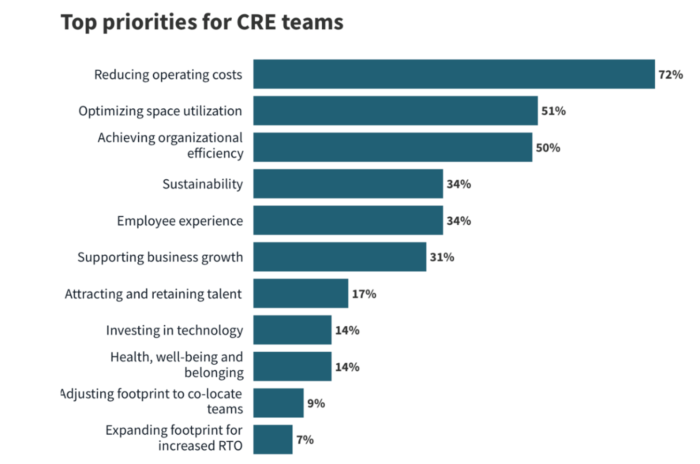
“According to JLL, 72 per cent of global companies regard reducing operating costs – such as rent and energy costs – as one of the primary tasks in the management of their commercial properties. We also see that ‘costs’ continue to play the most important role here in Denmark. In our annual expectations survey at EDC Erhverv Poul Erik Bech, in which more than 1,800 respondents took part to share their expectations for 2026, 68 per cent cited price and rent as one of the most important factors when choosing premises.”
Strategic parameters are gaining ground
Despite the focus on costs, strategic parameters are also becoming more important, points out Joseph Alberti: “Globally, JLL reports that 51 per cent of companies are actively working to optimise space utilisation by, among other things, reducing the number of vacant square metres and adapting office environments to hybrid working patterns. The average office utilisation rate worldwide currently stands at 54 per cent, whilst companies’ target is to reach 79 per cent. However, a higher utilisation rate does not necessarily mean a reduction in square metres, as 43 per cent expect staff numbers to grow and around one-third believe they will need larger office spaces in the future.”
Helle Nielsen Ziersen, Head of EDC International Poul Erik Bech, continues: “JLL highlights the development of office environments that support organisational efficiency as the third most important focus area (50 per cent). This is about design and layout that can promote more efficient workflows and, for example, enhance collaboration across a company’s various departments. This can be achieved through more meeting and project areas, flexible workstations or activity-based work zones. Our expectations survey at EDC Erhverv in the Danish market shows that 29 per cent of Danish companies regard flexibility as one of the most important factors when choosing premises.”
Offices at the forefront of sustainability
Employee experience (34 per cent) and sustainability (34 per cent) share fourth place. 73 per cent of global employees believe that green surroundings can enhance employee wellbeing, whilst 67 per cent prioritise workplaces in vibrant and attractive urban environments. At the same time, Helle Nielsen Ziersen, who holds a Mini-MBA in sustainability/ESG, expects the area to gain greater significance in the coming years:
“The EU’s revised Energy Performance of Buildings Directive (EPBD) has now been transposed into national legislation in all Member States. Broadly speaking, this means that the 16 per cent of commercial buildings with the lowest energy efficiency must be energy-optimised by 2030, whilst the 26 per cent with the poorest performance must be improved by 2033. At the same time, all new commercial buildings from 2030 onwards must be classified as zero-emission buildings, whilst the EU’s entire building stock is expected to be emission-free by 2050 at the latest. No players in the sector – whether companies, developers, investors or tenants – can therefore ignore the fact that ESG and energy will play an even greater role over the coming years.”
“In the Danish market, the proportion of those who do not factor sustainability into their investment strategy at all has fallen from 30 per cent in 2022 to 17 per cent in 2026. At the same time, 36 per cent say they have already optimised one or more properties for energy efficiency. Office properties have long been ahead of other property types, and a building’s sustainability performance is closely linked to its image, the organisation’s own ESG targets and its ability to attract staff. Our expectations survey at EDC Erhverv also shows that 75 per cent of investors expect tenants to be willing to pay more for a sustainable office space. The trend therefore points towards a market where demand for modern, energy-efficient and certified office properties will continue to rise, whilst older properties risk falling behind in terms of both rent levels and value.”
Five office trends
JLL and EDC Erhverv’s Poul Erik Bech highlights five trends to watch in the global office property market.
1) Flexible office portfolios: Rising demand for flexible office solutions that can be adapted to hybrid working and changing space requirements, including co-working and satellite offices. Increased use of occupancy data to optimise space utilisation, whilst shorter and more flexible leases are replacing traditional, long-term agreements.
2) Experience-based workplaces: The office must support a balance between work, private life and experiences. Increased demand for centrally located premium offices with access to cafés, shops, nature and other services, whilst HR data is increasingly being used to create more convenient and personalised workplaces.
3) AI – from experimentation to intelligent infrastructure: Most are still in the testing and implementation phase, but AI is increasingly being integrated into property management, with a focus on areas such as energy consumption and space utilisation. This is driving up demand for intelligent buildings and smart building technology, whilst older properties with outdated systems and limited digital infrastructure will face challenges.
4) Future-proof Facility Management: Facility Management is evolving towards a more strategic and data-driven operational function, with a focus on cost-effectiveness, proactive maintenance and staff wellbeing. This is driving demand for properties that support efficient operations, modern FM solutions and a healthy and safe working environment.
5) ESG and Energy Management: Energy management and energy efficiency are becoming key factors in reducing operating costs, strengthening the ESG profile and safeguarding property value. This is driving demand for certified buildings and the refurbishment of existing offices, whilst older, energy-intensive buildings with high operating costs are coming under pressure.
Source: JLL and EDC Erhverv Poul Erik Bech
See the full list here: